The 1-3-5 Rule Works Until Your One Big Thing Takes Three Days
1-3-5 rule5 min read
Learn how to effectively apply the 1-3-5 rule in task planning, especially when faced with larger tasks. Discover how otoodo can help.
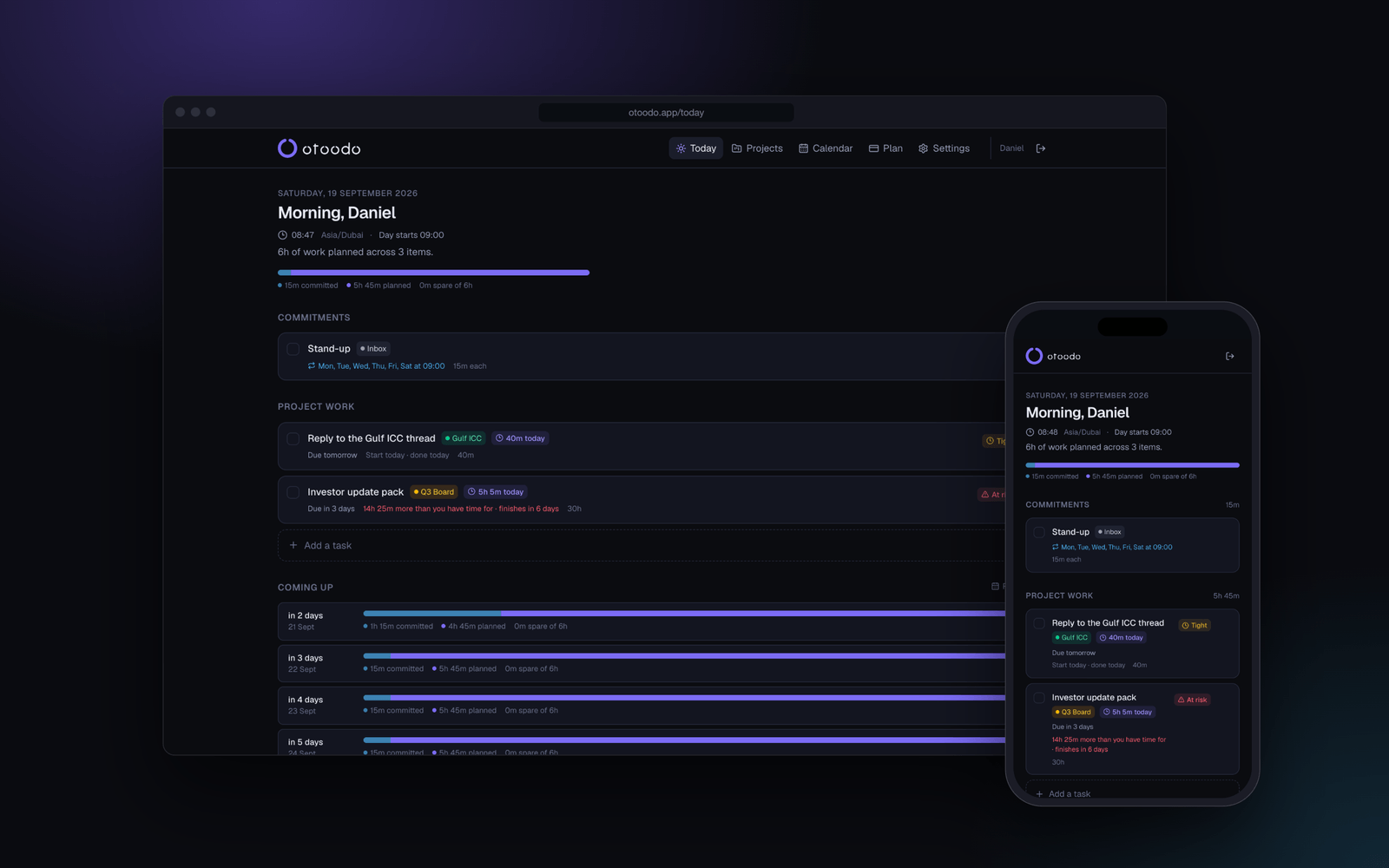
The 1-3-5 rule is a popular productivity method that suggests you should aim to complete one big task, three medium tasks, and five small tasks each day. On the surface, this approach seems straightforward and manageable. However, what happens when your one big task takes three days to complete? This is where the arithmetic of task planning becomes crucial. Understanding how to allocate time effectively can make a significant difference in meeting deadlines and maintaining productivity.
The short version
- The 1-3-5 rule suggests a daily task allocation of one big, three medium, and five small tasks.
- When a big task takes longer than a day, it must be divided into manageable parts.
- Using a task planner like otoodo can help distribute workload effectively, ensuring deadlines are met.
- Accurate time estimates are essential for effective planning.
Understanding the 1-3-5 Rule
The 1-3-5 rule is designed to simplify daily task management by providing a clear structure. The idea is to focus on accomplishing a balance of tasks that vary in size and complexity. Here’s a breakdown of the components:
- One Big Task: This is typically your priority task for the day, which requires significant time and effort.
- Three Medium Tasks: These tasks are important but can be completed in a shorter time frame compared to the big task.
- Five Small Tasks: These are quick wins—tasks that can be completed in 15-30 minutes.
The beauty of this rule lies in its simplicity, allowing you to focus on a manageable number of tasks each day. However, it assumes that tasks fit neatly into a single day, which is not always the case. When a task expands beyond a day, the effectiveness of this method can diminish.
What Happens When a Task Takes Longer?
Consider a scenario where your big task is to complete a project that requires 20 hours of work. If you are working with the 1-3-5 rule, you might plan to tackle this task over several days. However, without proper planning, you may find yourself cramming work into the last days, risking burnout and missed deadlines.
Example Breakdown
Let’s say you have a week to complete your project, and your typical workday allows for 6 focused hours. Here’s how the arithmetic works:
- Total Hours Available in a Week: 6 hours/day * 5 days = 30 hours
- Task Duration: 20 hours
- Remaining Hours After Task: 30 hours - 20 hours = 10 hours available for other tasks
With this in mind, you can allocate your time as follows:
Spreading the Work
When faced with a task that demands more time than is available in a single day, the solution is to spread the work. Instead of trying to fit the entire 20-hour task into one day, break it down into daily portions. This is where otoodo can assist you in planning your week effectively.
Daily Shares
If your project requires 20 hours, you could allocate approximately 4 hours each day over five days. Here’s how you can structure your week:
The Importance of Accurate Time Estimates
Accurate time estimates are vital for effective task management. The 1-3-5 rule relies on your ability to gauge how long each task will take. If your estimates are off, you risk overcommitting yourself or underestimating the time needed for completion.
Estimation Techniques
Here are some techniques to improve your task estimation:
- Historical Data: Look back at similar tasks you’ve completed in the past. How long did they take? Use this data to inform your current estimates.
- Break It Down: Divide larger tasks into smaller components and estimate the time for each. This can provide a clearer picture of the overall time required.
- Buffer Time: Always add a buffer to your estimates. For instance, if you think a task will take 2 hours, estimate 2.5 hours to account for unexpected delays.
Using otoodo can help you refine your estimates by tracking your time on tasks and providing insights into your productivity. This data can be invaluable for future planning.
When the 1-3-5 Rule Breaks Down
While the 1-3-5 rule is a solid framework for prioritising tasks, it has its limitations. Here are a few scenarios where it may not hold:
- Complex Projects: Some projects may require more than just one big task and could benefit from a more detailed breakdown.
- Unexpected Interruptions: If you frequently face interruptions, the 1-3-5 rule may not be adaptable enough to accommodate these changes.
- Team Dynamics: If you're working in a team environment, the 1-3-5 approach may not account for collaborative tasks that require coordination.
In these cases, consider adjusting your approach to task management. Instead of rigidly adhering to the 1-3-5 rule, focus on the overall workload and deadlines, using tools like otoodo to help adapt your plans as situations change.
Using otoodo for Effective Task Management
To enhance your task management, consider integrating otoodo into your workflow. With its unique approach to capacity-aware planning, otoodo can help you determine exactly what today must contain to keep you on track for your deadlines.
With otoodo, you can:
- Visualise Your Workload: See how your tasks fit within your available hours, helping you avoid overcommitment.
- Plan for Delegates: If you have team members, assign tasks without requiring them to log in, making collaboration easier.
Conclusion
The 1-3-5 rule provides a solid foundation for daily task management, but it requires flexibility when faced with larger tasks. By breaking down tasks into manageable portions and accurately estimating time, you can maintain productivity and meet deadlines without the stress of last-minute cramming.
Using a tool like otoodo can further enhance your planning process, ensuring that you stay on top of your workload and deadlines. With otoodo, you can start with a free plan that allows you to manage three projects effectively.
Fourteen days free, no card. Start now.