How to tell a client their deadline is impossible
Clients6 min read
The conversation everyone dreads, why timing matters more than wording, and a script that works.
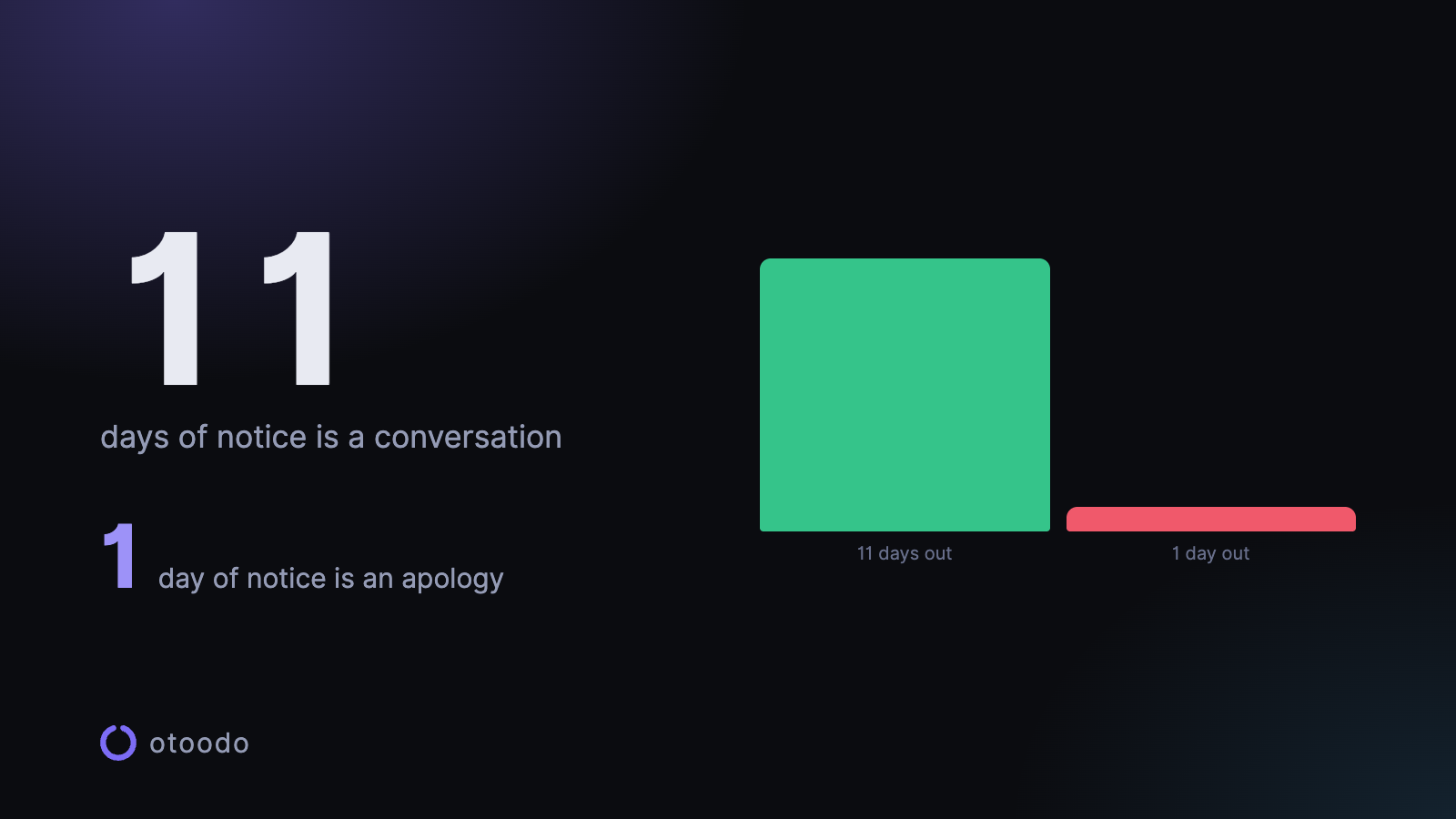
Nobody wants this conversation. So it gets postponed, and the postponing is what turns a manageable conversation into a bad one.
Here is the thing worth internalising before any of the wording matters: the difficulty of this conversation is almost entirely a function of when you have it. Eleven days out it is a planning discussion between two professionals. The afternoon before, it is an apology. Same facts, same words, completely different meeting — and the only variable you controlled was the date on the calendar when you opened your mouth.
Which means the real skill is not delivering bad news well. It is finding out early, which is arithmetic, not courage.
Find out early
The calculation takes five minutes. List everything committed between now and the date. Put an hour figure against each. Count the working days and multiply by your real focused hours — four or five a day, not eight. Subtract standing commitments. Compare.
Do it when the request arrives, not when the deadline approaches. Do it again whenever anything changes: a slipped dependency, a task that turned out bigger, a new piece of work squeezed in. Most missed deadlines were not visible at the start; they became impossible somewhere in the middle, quietly, and nobody was running the sum on the day it happened.
That is the entire argument for having software do it continuously rather than doing it yourself, once, at the wrong moment.
Bring the number, not the feeling
There are two versions of this conversation.
"I'm a bit worried about the 19th, things are quite tight at the moment."
"The 19th needs 47 hours of work. I have 39 available. I'm eight hours short."
8 hours short.
The first invites reassurance — "I'm sure you'll be fine" — because you have described a mood and moods can be talked out of. It also, unfairly, reads as either an excuse or a negotiation.
The second cannot be argued with, because it is not an opinion. It moves the conversation past whether there is a problem and straight to what to do about it, which is the only useful part. It also, quietly, makes you the person who knows their own capacity — which is a reputation worth more than any single delivered date.
Show your working if asked. Nobody ever objects to arithmetic they can check.
Bring the three options
There are exactly three ways out, and the client needs to choose. Bring all three, with your recommendation.
More hours. You work later, or you bring someone in. Say what it costs, in money if someone is being paid and in quality if they are not. This is the lever clients assume you will pull silently, and the one you should be slowest to offer.
A later date. Say the date that does work. Not "a bit more time" — the 26th. A specific new date is a proposal; vagueness is a problem handed back.
Less work. Say exactly what comes out and what that costs them. Often this is the best option and the client would have chosen it happily, but only if someone told them it was available. They cannot cut scope they don't know is optional.
Then recommend one. You know the work better than they do, and a list of three options with no opinion attached is a decision you have declined to help with.
A script
Hi Sarah,
I've been through the plan for the 19th and I want to flag something now rather than closer to the date.
The proposal is about ten hours of work. Between now and the 19th I also have the Almadar tender on the 15th and the monthly reporting on the 17th, and once those and my standing meetings come out, I have 39 usable hours against 47 hours of committed work. I'm eight hours short.
Three ways I can see:
- Move the proposal to the 26th. Everything else lands as promised and the proposal gets the time it needs. This is what I'd recommend.
- Cut the market-sizing section. That's about nine hours and gets us to the 19th. We'd be submitting without the comparative data.
- Bring in Talha for two days to take the reporting off me, at [rate]. The 19th holds and everything else is unaffected.
Happy to talk it through — but I'd rather you had the choice now than an apology on the 18th.
Daniel
The three options in that email, side by side:
| Option | What it costs the client | Does the 19th hold? |
|---|---|---|
| Move the proposal to the 26th | A week | No, but everything else lands as promised |
| Cut the market-sizing section, about nine hours | The comparative data | Yes |
| Bring in Talha for two days | His rate | Yes |
Note what that email does not do. It does not apologise, because nothing has gone wrong yet. It does not blame the client for the volume of work. It does not hedge. It gives a number, three options, a recommendation and a reason, and it takes about ninety seconds to read.
Three things not to do
Don't absorb it silently. Working the weekend to make an impossible date possible teaches the client that impossible dates are possible. You will be given another one. This is how people end up permanently at capacity and permanently resentful, and it started with a kindness.
Don't disclose it late "in case it works out". It won't, and the cost of being wrong is asymmetric: telling someone early about a problem that resolves itself costs one email, while telling them late costs the relationship.
Don't present it as your failure when it is arithmetic. "I'm so sorry, I've overcommitted" invites a judgement about your competence. "Here is the capacity and here is the work" invites a decision about priorities. The second is both truer and better for you.
| Don't | What it costs |
|---|---|
| Absorb it silently | The client learns that impossible dates are possible, and sends another |
| Disclose it late | Early costs one email. Late costs the relationship |
| Call it your failure | A judgement about your competence, instead of a decision about priorities |
The reframe
Handled early, with a number, this conversation is not a confession. It is the main thing a client is buying from a professional: someone who knows what fits and says so in time to act on it.
The people who are trusted with the important work are not the ones who never raise a problem. They are the ones who raise it eleven days out, with three options and a recommendation.
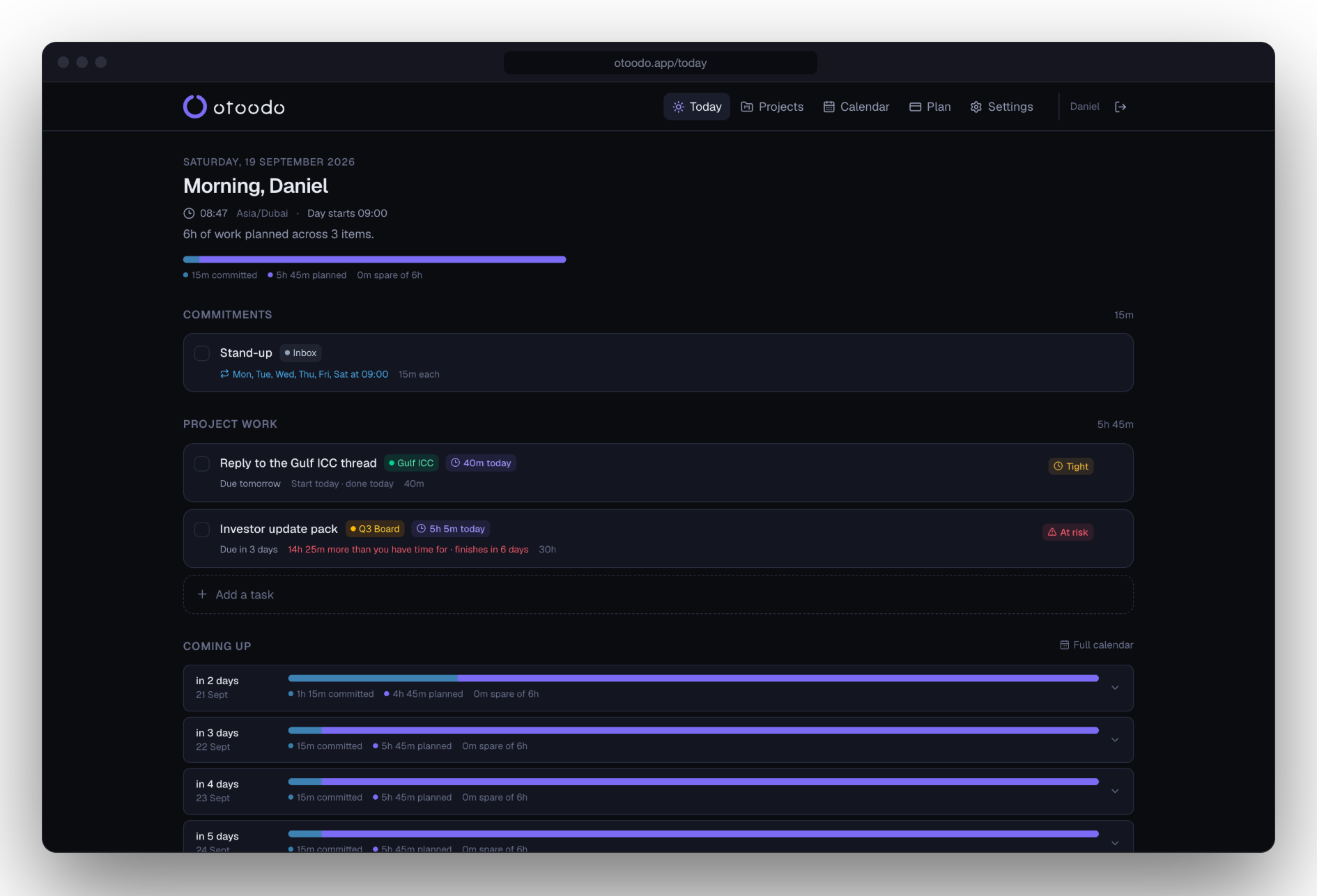
otoodo runs this calculation continuously, so the eight-hour shortfall turns up on the day it appears rather than the week it bites. Fourteen days free, no card.