How to work out whether a deadline is actually possible
Method6 min read
A five-minute calculation you can do on paper, and the two mistakes almost everyone makes doing it.
Somebody has asked you for a date. You have a rough feeling about it. The feeling is usually wrong, and it is wrong in a predictable direction.
Here is the calculation that replaces the feeling. It takes five minutes on paper and you can do it before you reply to the email.
The calculation
Step 1 — list everything already committed between now and the date.
Not just the piece of work being asked about. Everything with a deadline on or before it. This is the step people skip, and skipping it is why the answer comes out wrong: a new deadline is never assessed against an empty calendar, but that is how it always gets assessed.
Step 2 — put an hour figure against each one.
Rough. "About a day" is a fine unit. What matters is that a number exists, because you cannot add up feelings.
Step 3 — count the working days between now and the date, and multiply by your real focused hours per day.
The word doing the work there is focused. See below; it is where most of the error lives.
Step 4 — subtract your standing commitments.
The Monday call. The stand-up. The Friday report. Anything that recurs is not available to this piece of work and never was. Take it off the top before you compare anything.
Step 5 — compare.
If committed work is greater than available hours, the deadline is impossible. Not tight. Impossible. Say so now, while there are still options.
An example
It's Monday the 8th. A client asks for a proposal by Friday the 19th — twelve days, nine of them working days.
Already committed in that window:
| Work | Hours |
|---|---|
| Tender response, due the 15th | 12 |
| Two client review sessions plus prep | 6 |
| Monthly reporting, due the 17th | 4 |
| The new proposal, estimated | 10 |
| Total | 32 |
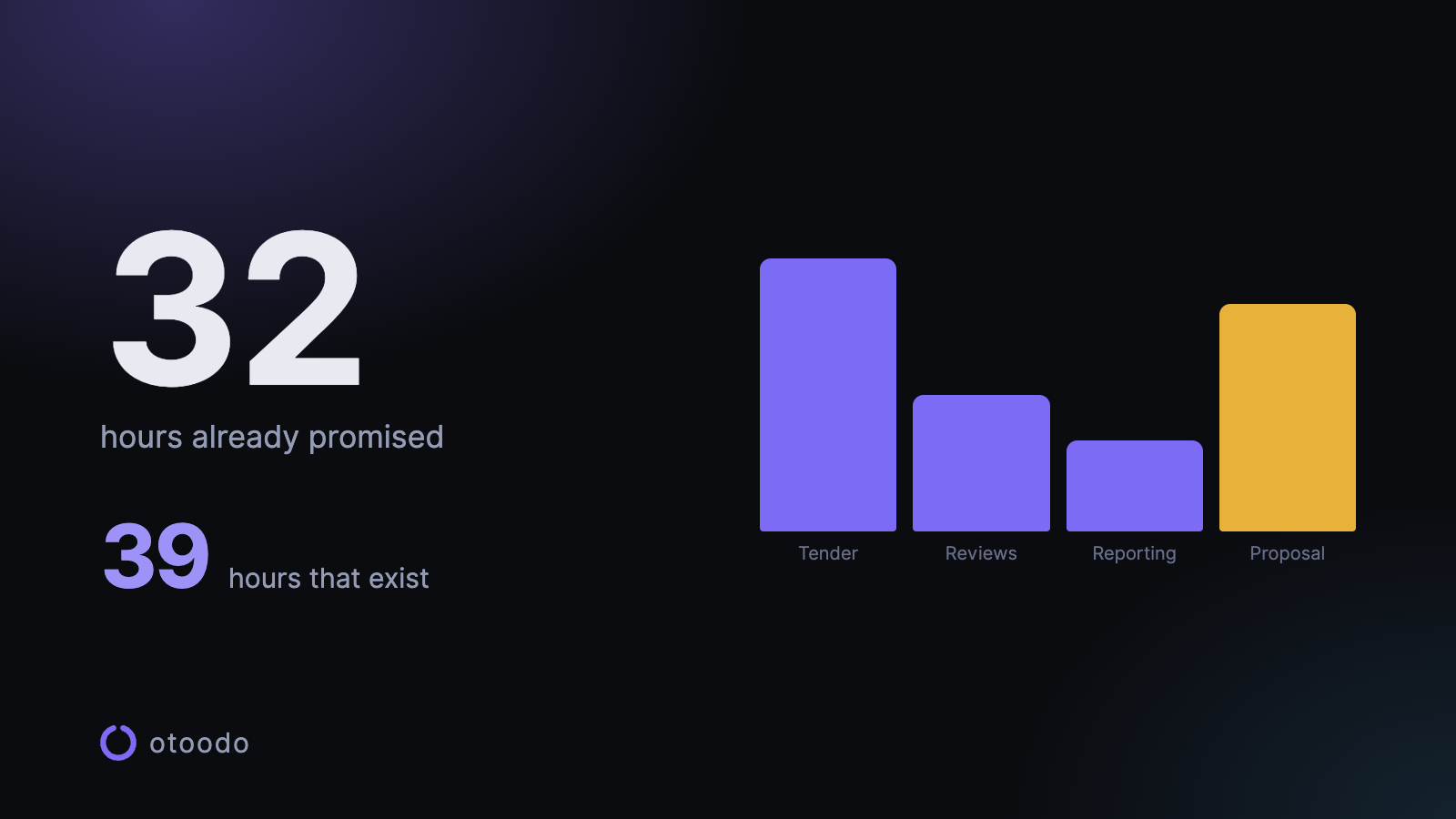
Available: 9 working days × 5 focused hours = 45 hours. Minus standing commitments — a daily stand-up and a weekly management meeting, about 6 hours across the period — leaves 39.
Fits, with 7 hours spare.
32 against 39. It fits, with 7 hours of slack across nine days. That is thin, but it is a yes, and now it is a yes you can defend.
Change one number — the tender turns out to be 20 hours rather than 12 — and it becomes 40 against 39. Now the honest answer is "yes, if the tender doesn't grow. It has already grown once, so let me come back to you on Wednesday when I know." That is a far better email than a confident yes followed by a Thursday apology.
1 hours short.
Mistake one: counting hours you don't have
Everyone does this. The working day is eight hours, so the calculation uses eight hours.
It isn't eight. Between meetings, email, interruptions and the twenty-odd minutes it takes to get back into something after each one, most people doing knowledge work get four to five hours of genuinely focused output from an eight-hour day. On a day with three meetings in it, two.
| A day with… | Focused hours you can plan on |
|---|---|
| No meetings, door shut | 5 to 6 |
| A normal day | 4 to 5 |
| Three meetings | 2 |
| Travel, or a workshop | 0 to 1 |
Use eight and every estimate you produce is around 60% too optimistic. Not occasionally — structurally, every single time, which is why the same person misses the same kind of date over and over and concludes they are bad at estimating. They are not. They are doing correct arithmetic on a wrong number.
Track it for a fortnight if you don't believe the figure. Write down, each day, the hours you actually spent moving committed work forward. Most people are shocked, and the shock is worth more than any planning tool.
Mistake two: assessing the new thing on its own
The question that gets asked is "can I do ten hours of work in nine days?" and the answer is obviously yes.
The question that matters is "can I do ten hours of work in nine days given everything else I have already promised?" Those two questions have different answers surprisingly often, and only the second one is the question the client is really asking.
This is why the calculation starts by listing everything. A deadline is never assessed alone. It is also the sum a sorted to-do list never does, which is why the list looks fine right up until Thursday.
What to do when the answer is no
You have exactly three levers, and it is worth being blunt about them because people waste days looking for a fourth.
- More hours. Work later, bring someone in, buy the time. This is the lever people reach for first and it is the worst of the three: it is finite, it degrades quality, and it is not repeatable.
- A later date. Almost always available, almost never asked for, and almost always granted when it is asked for eleven days out rather than one.
- Less work. Cut the scope. Half the proposal, delivered on the 19th, is usually worth more to the client than all of it on the 26th — but only they can decide that, and only if you tell them in time.
| Lever | What it costs | When to use it |
|---|---|---|
| More hours | Quality, and your evenings. Not repeatable | A shortfall of a few hours, once |
| A later date | One awkward email | Almost always, if you ask early |
| Less work | A smaller deliverable | When the date is fixed by something real |
There is no fourth lever. Working harder is lever one wearing a disguise. If the answer is a later date, how you tell the client matters less than when you tell them.
Doing it continuously
The reason people don't do this calculation is not that it is hard. It is that it goes stale in a day. Estimates change, work arrives, a client slips a date, and the number you worked out on Monday is wrong by Wednesday.
Which makes it exactly the sort of thing that should not be done by hand. Put the four numbers in once — what, when, how long, and how many hours your days really hold — and the sum can be redone every time anything changes, without anyone thinking about it.
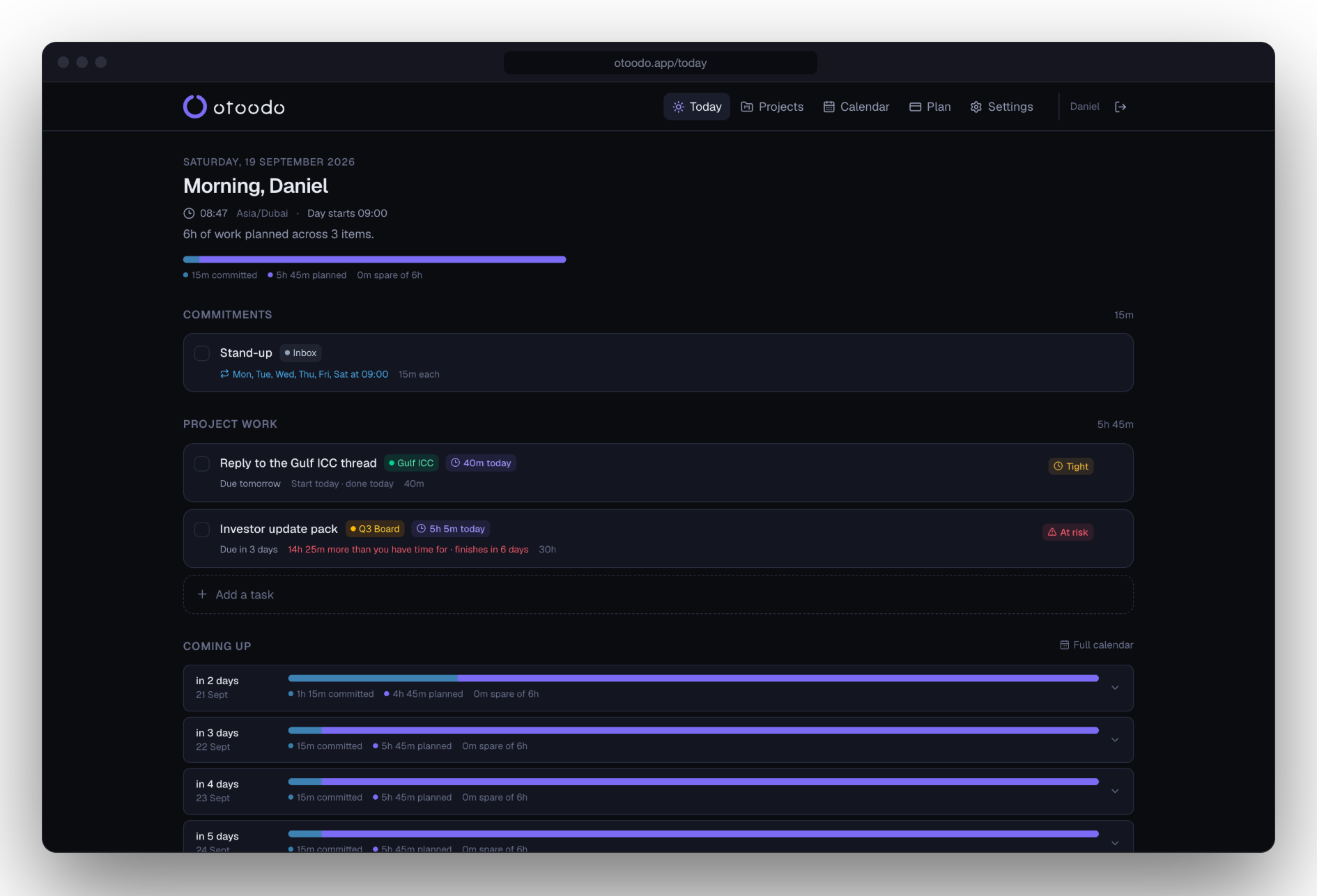
That is what otoodo is. It does this calculation continuously, tells you what today has to contain, and when a deadline stops being possible it says so in hours rather than in a red flag. Fourteen days free, no card.