How to plan a team's week when the team won't use your tools
Teams6 min read
Every small agency buys the tool, fills it in, and ends up the only one opening it. There is a way round that.
You bought Asana. Or Monday, or ClickUp, or you built it in Notion over a weekend that you enjoyed more than you'll admit.
You set up the projects. You wrote the conventions in a pinned doc. You showed everyone in a Tuesday meeting where they nodded.
Six weeks later you are the only person who opens it. The work is happening in WhatsApp and email and a shared drive, and the tool has become a second job: you reconcile reality into it every Friday so that it isn't a lie.
This is not a failure of your team, and it is not a failure of the tool. It is a structural thing, and once you see it you can plan around it.
Why adoption fails, specifically
The tool asks for work that only benefits someone else. A designer updating a task status is not helped by having updated it. You are. You have asked five people to spend ten minutes a day producing information for one person's dashboard, and nobody has ever sustained that except under management pressure you would rather not apply.
It is a second place to be. The work arrives in email and Slack. The tool is somewhere else. Any system that requires a deliberate context switch to maintain loses to the system where the work already is.
The value is invisible at their end. You can see the overload. They see a form. And the value you get is real — but it is not their value, and asking people to do unpaid data entry for someone else's clarity is a hard sell repeated daily.
It scales down badly. These tools are built for teams of forty with a project manager whose job this is. At five people, the overhead is the same and the benefit is smaller.
The move: separate planning from doing
The unstated assumption in every tool of this kind is that the people doing the work must also maintain the plan.
Drop that assumption and the problem mostly dissolves.
One person — you, probably, because you already do this in your head — holds the plan. Everyone else does their work and is told what it is. No logins, no statuses, no conventions, no adoption problem, because there is nothing for anyone to adopt.
This sounds like a step backwards. It isn't, for three reasons.
It is already what is happening. You are already reconciling reality into the tool every Friday. You are already the only one who knows the shape of the week. All this does is stop pretending otherwise and stop paying the tax of the pretence. It is the same reason the capacity spreadsheet keeps dying.
Planning is genuinely a specialist job. Knowing that a piece of work is twelve hours rather than six, that a client will slip, that Tuesday's meeting will eat the morning — that is judgement built from running the business. It is not distributed knowledge and it does not become better by being distributed.
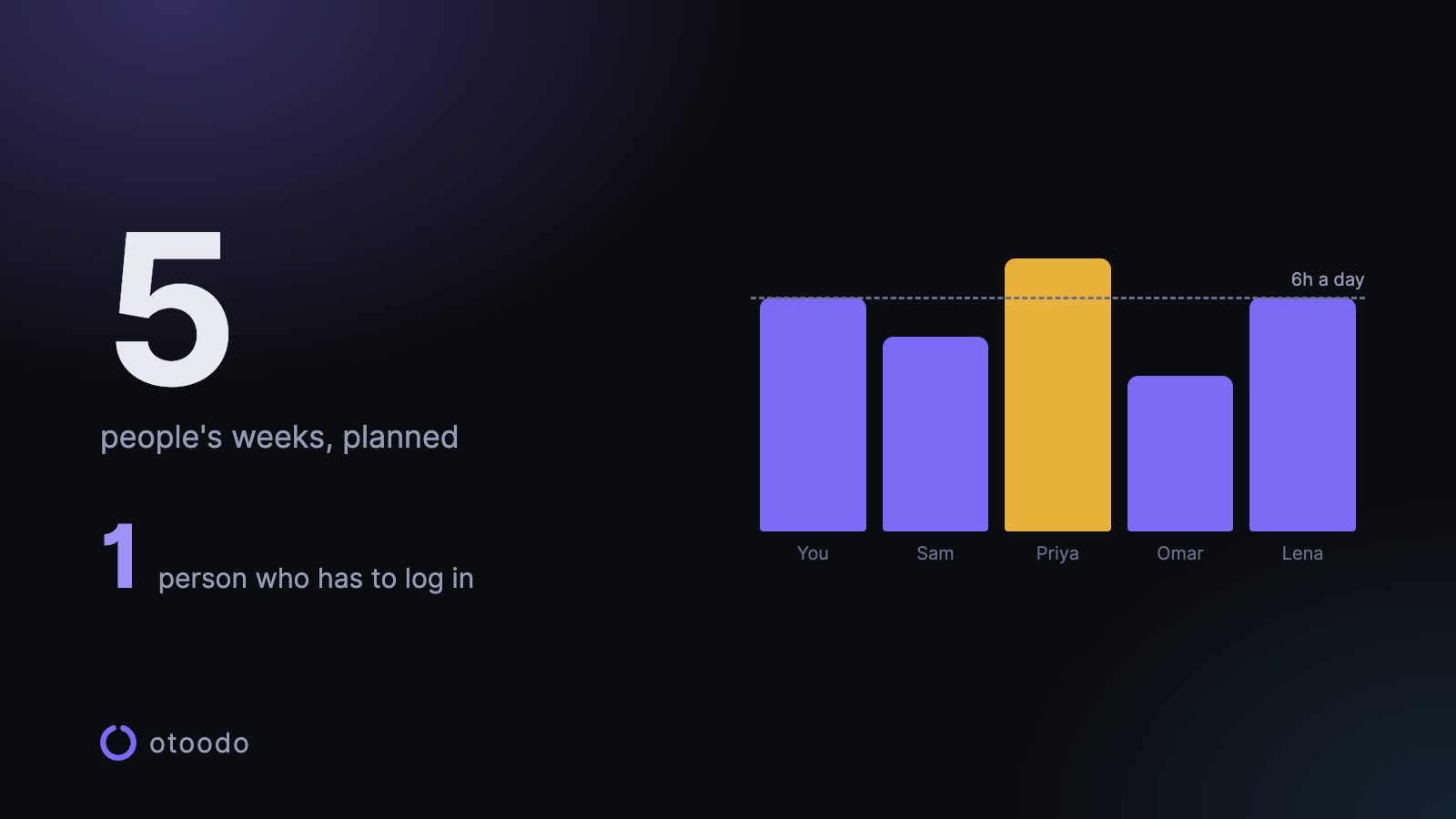
Five people do not need shared visibility. They need to know what they're doing this week. That is a message, not a dashboard.
| A shared tool | One person plans | |
|---|---|---|
| Who maintains the plan | Everyone in theory, you in practice | You |
| What the team has to adopt | Logins, statuses, conventions | Nothing |
| How people learn their week | A dashboard nobody opens | A message |
| Where it stops working | It scales down badly to five people | Around eight or ten people |
What the planning side then needs
If one person holds the plan, that person needs a tool that does the arithmetic rather than one that stores everyone's status updates. Four things:
Each person's real hours, individually. Not a headcount, not one capacity number. Talha works six hours a day, four days a week. Sara is full time but Thursdays are meetings. A plan that assumes everyone has forty hours is wrong about everyone.
| Person | What the plan assumes | What they really have |
|---|---|---|
| Talha | 40h | 24h: six hours a day, four days a week |
| Sara | 40h | Full time, minus Thursdays |
16 hours short.
Assignment that moves the load. Give a task to Talha and it should come out of Talha's hours, not yours. That single behaviour is what makes delegation visible: your Thursday frees up and his fills, on screen, immediately.
A per-person answer, not just a total. "The team has capacity" is not useful when one person is at 130% and another at 40%. The overload is nearly always one person, and the fix is nearly always moving one task.
A refusal. When the work assigned to someone doesn't fit their week, the tool should say by how many hours, per person. That is the number you take into a Monday conversation.
What the team gets instead
They get told what they're doing. In whatever channel they already use — a message, a call, a printed list if that's what works.
And they get something better than a dashboard: a week that fits. The main experience of working in a badly planned small business is being given more than is possible and being blamed for the shortfall. Someone upstream doing the arithmetic properly fixes that, and it is felt long before it is noticed.
When to graduate
This approach has a ceiling, and it's honest to name it. Somewhere around eight or ten people, or when the work stops being deadline-shaped and starts being process-shaped, one person can no longer hold it and you need real shared tooling — and by then you will have someone whose actual job is to maintain it.
Below that, the shared tool is usually costing more than it returns.
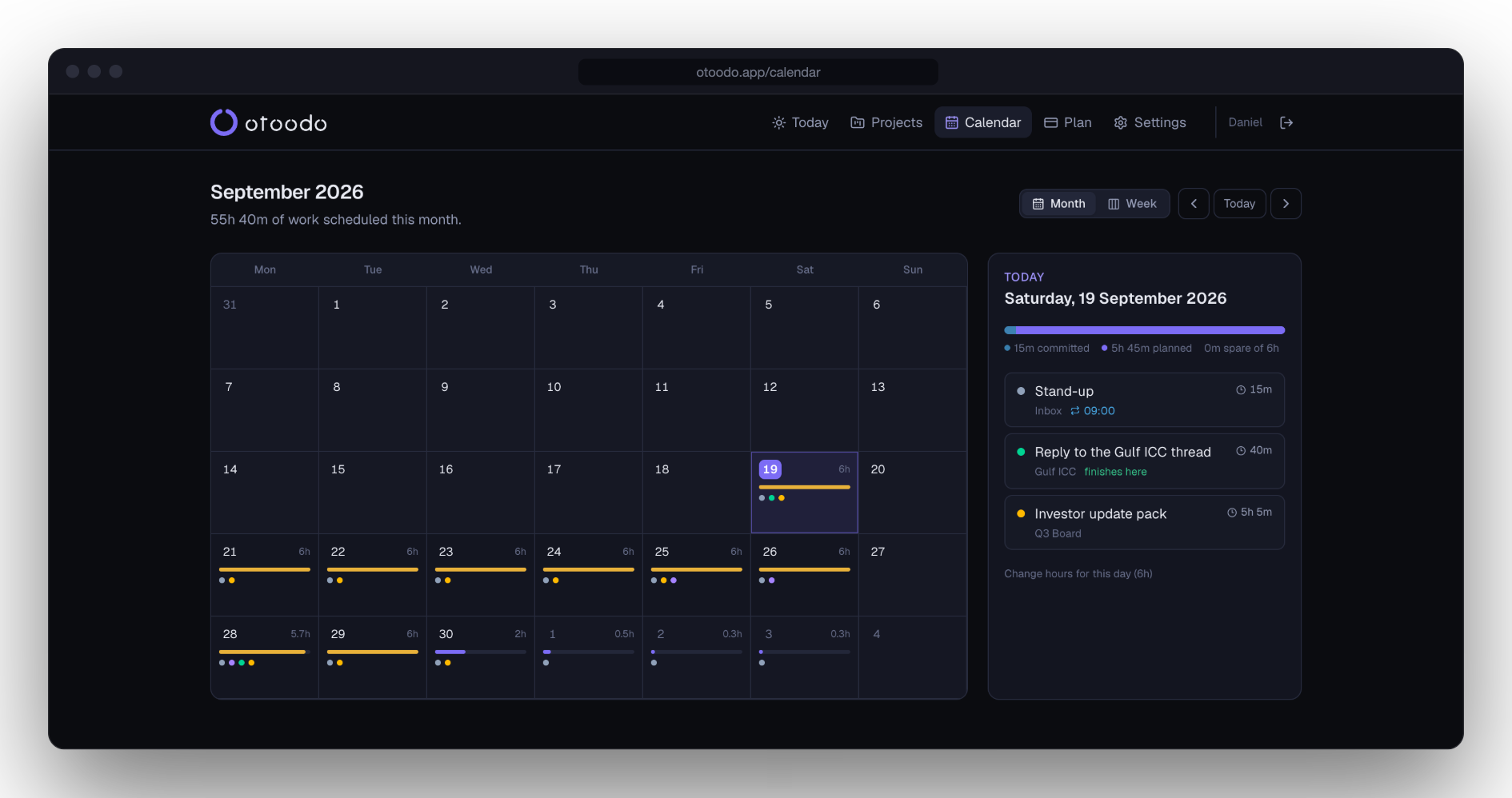
otoodo is built for exactly this: you plan, each person has their own working week, delegated work comes out of their hours rather than yours, and nobody needs a login but you. Fourteen days free, no card.