Saying No to More Work is Easier with a Number in Your Hand
how to say no to more work4 min read
Learn how to say no to more work effectively with clear numbers. Use otoodo's deadline-aware planning to assert your limits.
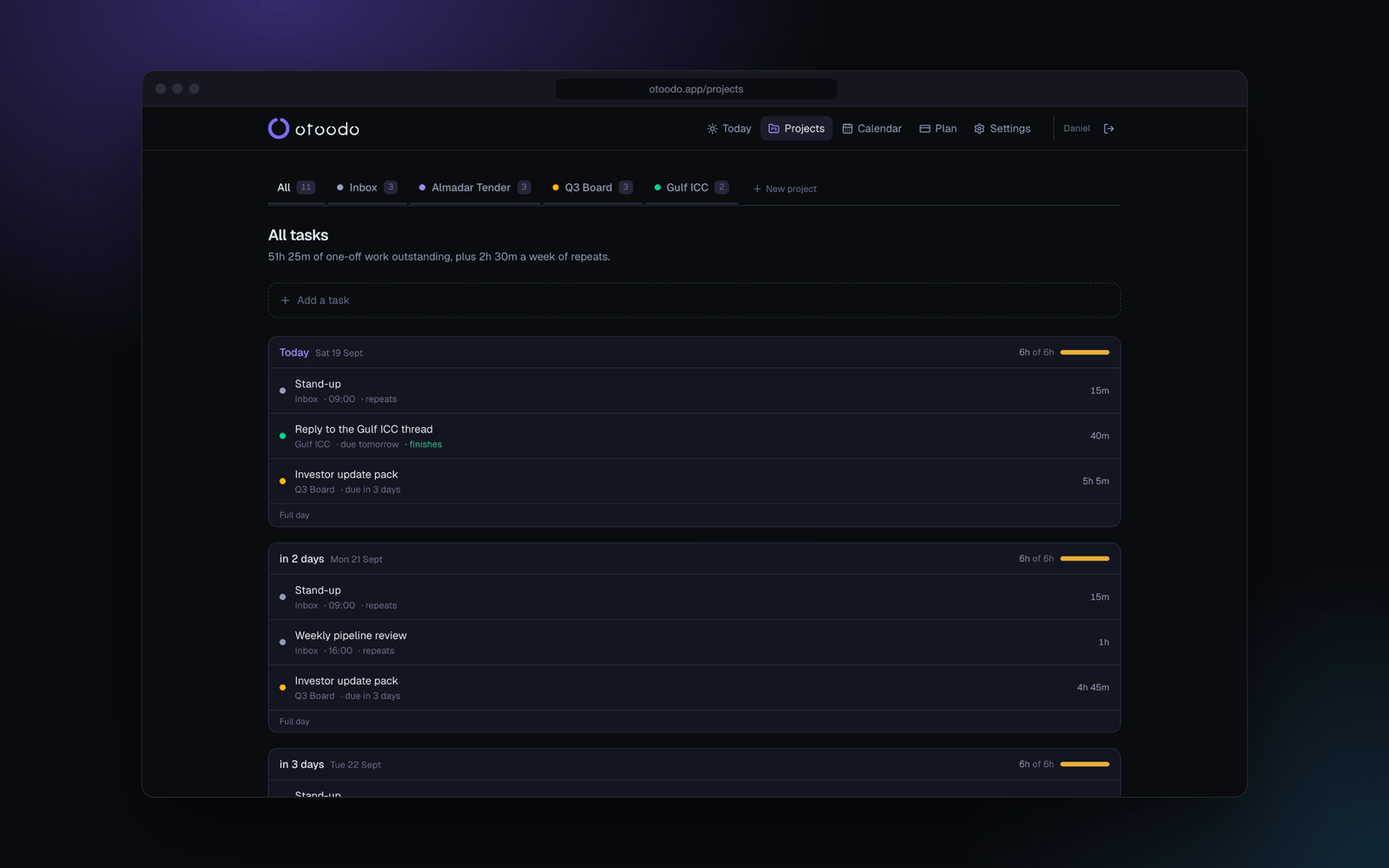
Overcommitment is a common issue for professionals managing multiple deadlines. When clients or colleagues approach you with new tasks, simply stating, "I am busy" often invites negotiation. Instead, having concrete figures at your disposal makes it easier to decline additional work. This article will guide you on how to say no to more work effectively by using specific numbers to assert your limits.
The short version
- Saying no is easier when you have specific numbers.
- Use clear estimates to communicate your availability.
- Present concise scripts to convey your message.
- Leverage otoodo’s planning capabilities to manage your workload.
Understanding Your Workload
When you face a new request, it’s crucial to understand how much work you can realistically take on. This involves knowing your available hours, existing commitments, and the time required for new tasks. To effectively communicate your limits, you need to have a clear picture of your workload and how much time each task requires.
Estimating Your Available Hours
Start by calculating your available hours for the week. Here’s a simple method to do that:
- Determine your working hours per day. For example, if you work six hours a day, that’s 30 hours a week.
- Subtract recurring commitments. If you have two hours of meetings each day, that reduces your available hours.
- Consider one-off tasks. If you have any special commitments, account for those as well.
Here’s a table to illustrate this:
The Arithmetic of Saying No
Having a clear understanding of your available hours allows you to communicate effectively when you need to say no. Instead of a vague response, you can provide a concrete number that illustrates your current capacity.
Script Examples
Below are three scripts you can use to decline additional work while providing the necessary context:
Script 1: The Direct Approach
"I appreciate the opportunity, but I currently have 20 hours of work planned for this week, and I can only take on an additional 5 hours before the deadline. This task requires 12 hours, so I won’t be able to accommodate it this time."
Script 2: The Collaborative Approach
"Thank you for considering me for this task. I have 20 hours available this week, and I estimate this task will take 12 hours to complete. Unfortunately, I can’t fit it into my schedule. Perhaps we can look at rescheduling it for next week?"
Script 3: The Data-Driven Approach
"I understand the urgency, but I only have 5 hours available before the 30th, and this task requires 12 hours. I can’t commit to it without compromising my current deadlines."
Using these scripts, you can decline additional work more confidently, armed with the numbers that underpin your decision.
The Importance of Accurate Estimates
One challenge in saying no is that estimates can sometimes be inaccurate. It’s essential to make your best guess based on past experiences and the complexity of the task at hand. Here’s how to improve your estimating skills:
- Reflect on past tasks. Consider how long similar tasks took you in the past.
- Break down tasks. Divide larger tasks into smaller components to make estimating easier.
- Consult with colleagues. If applicable, discuss with team members who have experience with similar tasks.
The Weakness of the Argument
While having numbers is powerful, it's important to acknowledge the limitations of this approach. Not all tasks can be neatly quantified, and some may require more flexibility. Here are some points to consider:
- Estimates can be wrong. A task might take longer than anticipated, and you may find yourself overloaded.
- Not all work can be spread. Some projects may have rigid deadlines that require immediate attention, regardless of your current workload.
- Different people have different capacities. What works for you might not apply to your colleagues or team members.
Leveraging otoodo for Efficient Planning
To make the process of estimating and managing your workload easier, consider using otoodo. It is a deadline-aware task planner that does the arithmetic for you, helping you understand how much time you need to allocate for each task.
Features of otoodo
- Deadline Awareness: otoodo calculates how many hours you have available and what today must contain to meet your deadlines.
- Task Estimation: You can input estimated times for your tasks, allowing otoodo to give you a clearer picture of your workload.
- Proportional Work Distribution: It spreads work over the available time, helping you avoid cramming at the last minute.
Using otoodo, you can easily assess your capacity and determine whether you can take on additional work. This will empower you to say no with confidence, backed by accurate data.
Conclusion
Saying no to more work is a skill that can significantly impact your productivity and mental well-being. By using specific numbers and clear estimates, you can communicate your limits effectively. Remember, it’s not just about saying no; it’s about protecting your time and ensuring that you can meet your existing commitments with quality work.
With otoodo, you can manage your tasks and deadlines more effectively, ensuring you always have the numbers you need to assert your limits. Fourteen days free, no card. Start your journey today.