You Have About 25 Focused Hours a Week, Not 40
how many hours can you actually work in a week4 min read
Discover how to accurately assess your weekly work hours by subtracting meetings and commitments. Learn how many hours you can actually work.
Every professional knows the feeling of a packed week. You might think you have 40 hours to work, but the reality is often quite different. When you subtract meetings, emails, and recurring commitments, you might find that you have only about 25 focused hours each week. Understanding this discrepancy is crucial for effective workload management and deadline planning.
The short version
- Most professionals have only about 25 focused hours available each week after accounting for meetings and commitments.
- Subtracting time for recurring tasks and meetings is essential for realistic planning.
- A worked example shows how to calculate your available hours.
- Tools like otoodo can help you plan against your actual available hours.
Understanding Your Work Week
The conventional 40-hour work week is a standard that many professionals aim for. However, this number often doesn’t reflect reality. In practice, various factors can significantly reduce the number of hours available for focused work. Let's break down these factors:
Meetings
Meetings are a common time sink in modern workplaces. According to a study by Doodle, professionals spend an average of 31 hours per month in unproductive meetings. This equates to about 7.5 hours a week. When you factor in the time spent preparing for meetings and following up afterward, the actual time lost can be even higher.
Emails and Communication
Managing emails and other forms of communication can also take a significant chunk of your time. Studies show that professionals spend about 28% of their workweek reading and responding to emails. This is equivalent to about 11 hours per week, further diminishing your focused hours.
Recurring Commitments
Recurring commitments, such as daily stand-ups or weekly reviews, also consume valuable time. For instance, if you have a daily meeting that lasts 30 minutes, that’s 2.5 hours a week. Add this to the other commitments, and the hours start to add up quickly.
The Arithmetic of Available Hours
To find out how many hours you can actually work in a week, you need to account for these factors. Here’s a simple calculation:
- Total Work Hours: 40 hours
- : 7.5 hours
A Worked Example
Let’s consider a more detailed example with real numbers. Suppose you have the following commitments in a typical week:
Adjusting Your Estimates
It’s essential to remember that estimates for tasks can also be off. If you consistently underestimate how long tasks will take, your workload can quickly spiral out of control. For instance, if you estimate a task will take 2 hours but it actually takes 4, you’ve effectively cut into your available hours even more.
The Honest Weakness of Estimates
While this arithmetic provides a clearer picture of your available hours, it’s important to acknowledge its limitations. Estimates can be inaccurate for several reasons:
- Underestimating Task Complexity: Some tasks may turn out to be more complicated than anticipated, requiring additional time.
- Unexpected Interruptions: Unforeseen events, such as urgent emails or last-minute meetings, can disrupt your plans.
- Team Dynamics: If you're working with a team, their schedules and commitments can also affect your available hours.
Despite these challenges, it’s better to have a realistic estimate rather than an idealistic one. This way, you can plan accordingly and avoid the stress of cramming work into the last minute.
Planning Against Your Available Hours
Knowing how many hours you can actually work in a week is just the first step. The next step is effective planning. Here are some strategies:
Prioritising Tasks
Focus on the most critical tasks first. Use a system to rank tasks by their urgency and importance. This will help ensure that you’re working on the right things during your limited focused hours.
Spreading Work, Not Cramming
Instead of trying to fit everything into the last few days before a deadline, spread your work over the available hours. This can reduce stress and improve the quality of your work.
Use Tools for Better Planning
Utilising a tool like otoodo can significantly enhance your planning capabilities. otoodo helps you track your tasks against your actual available hours, ensuring that you know what today must contain to meet your deadlines.
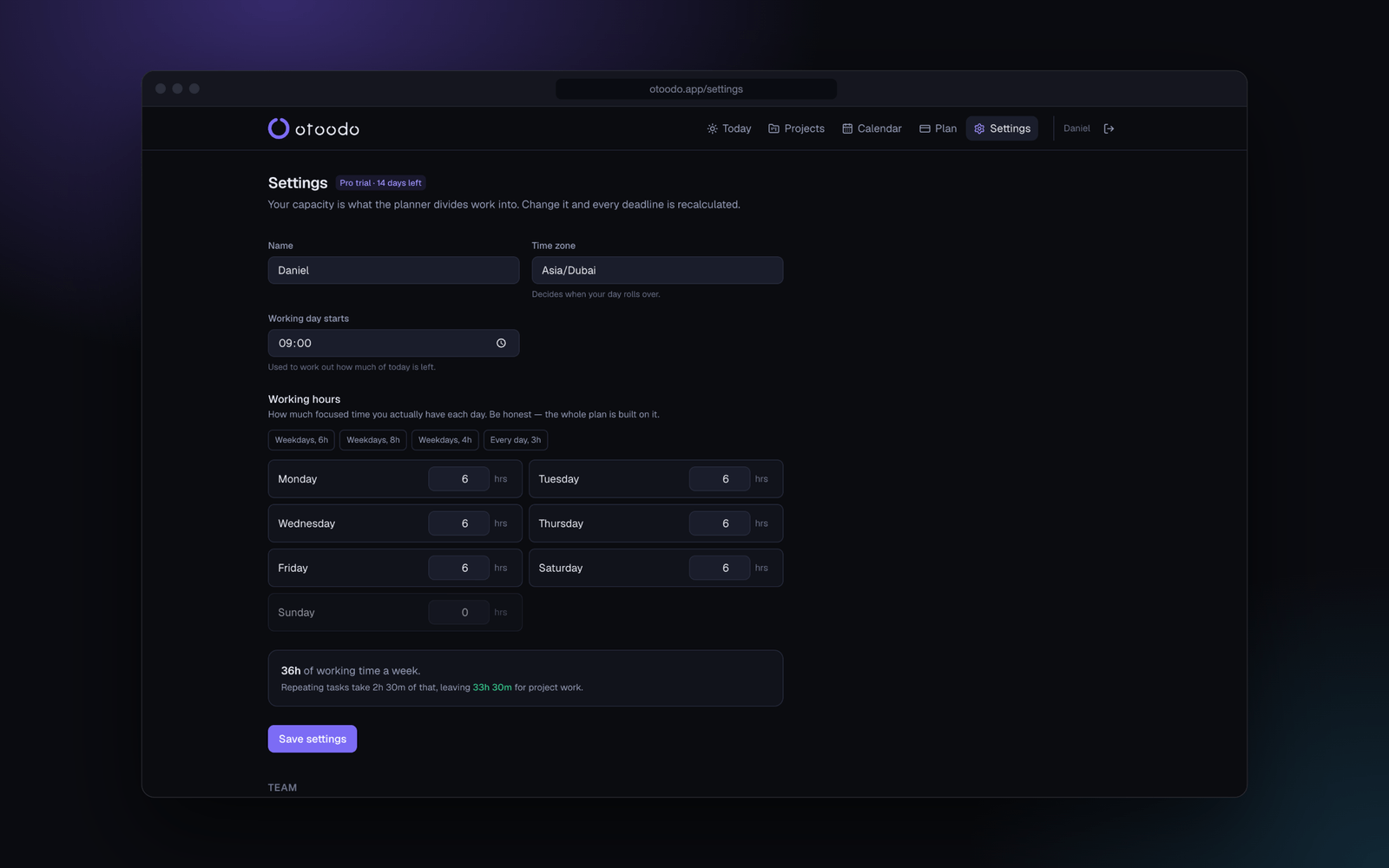
With otoodo, you can set your working hours per weekday, account for recurring commitments, and see your shortfall in hours. This way, you are always aware of your capacity and can adjust your workload accordingly.
Conclusion
Understanding how many hours you can actually work in a week is crucial for effective planning and workload management. By subtracting time for meetings, emails, and recurring commitments, you can arrive at a more realistic figure. This clarity enables you to plan your tasks effectively, reducing the risk of missed deadlines and overwhelm.
For those looking to manage their time better, otoodo offers a solution that helps you plan against your actual available hours. Start with fourteen days free, no card required, and see how it can transform your productivity. Fourteen days free, no card.